Sarah Axelrod: Q and A
Sarah Teal Axelrod is a writer and multimedia artist whose star is on the rise.

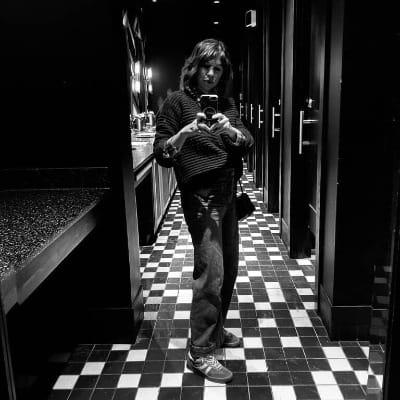
Sarah Teal Axelrod is a writer and multimedia artist whose star is on the rise. Her work moves between poetry, drama, memoir, photography, and film. Rooted in image, memory, and feeling, her practice shifts fluidly between language and visual form. She lives in Pennsylvania.
She is the Featured Writer at Aphrodite Press, who believes her work deserves to reach a wider audience.
She is currently working on a chapbook due for release in the autumn, as well as a new multimedia exhibition.
Sarah is considering offers of representation, sponsorship, and publication.
Q: Where did you grow up?
A: I grew up in Palm Beach Gardens, Florida.
A: My parents had corporate jobs. My mother was a graphic designer, and my father was a computer programmer and a musician. He was always playing old folk and blues music when he could. No one talked about emotions, but music and art were kind of the second and third languages for expression.
Q: What kind of reader were you as a child?
A: I didn’t love reading. I struggled with comprehension, and books felt closed to me, like something I couldn’t quite enter. It wasn’t until college that they opened. My professors illuminated texts in a way that made them feel alive.
Q: What early influences shaped your imagination?
A: Old movie musicals, certainly. My father also read me poetry at night, the haunting quality of Edgar Allan Poe and others.
The first book I read on my own was Trout Fishing in America by Richard Brautigan. It opened something in me, the idea that writing could transform simple, everyday moments into something worth illuminating. While studying acting, I loved working with texts rich in subtext. The playwrights who exemplified this most for me were Pinter and Beckett.
Q: You’ve said old movie musicals were formative for you. What did they mean in your early life?
A: I grew up watching old movie musicals—they were my companions and my first teachers about the world. As a deeply sensitive child, they felt like a place where feelings could exist at full volume, where nothing had to be hidden. They were a kind of home for me, almost like living inside language before I had the words for it.
Q: You trained in the arts from a young age. How did that shape your work?
A: I attended an arts middle and high school for acting, while my mother nurtured my visual sensibility by taking me to museums. I was deeply moved by images, but I had a natural pull toward language—I wanted to paint with words.
Q: When did writing begin to feel like your path?
A: In college, I fell in love with literature, especially in the classes of poet James Kimbrell. He encouraged us to attend poetry readings at a pool hall called The Warehouse, where visiting writers would perform. That world felt electric, intimate and alive.
Everything changed when I took a playwriting course with Mark Medoff. It felt like a perfect convergence: I could write the words that had always moved me in scripts, while also shaping visual worlds through language.
Q: How did graduate school expand your creative practice?
A: When Mark Medoff founded a new MFA program in dramatic writing, he invited me to join. The first semester immersed us in filmmaking, directing, editing, and shooting. I discovered a deep love for visual storytelling, which expanded my creative practice in ways I hadn’t expected.
Q: Who do you imagine when you write?
A: Readers who share emotional terrain with me, women navigating motherhood, adolescents without guidance or protection, and anyone working through traumatic experiences, looking for hope and healing and anyone who wants to understand those experiences. It’s important to balance life's difficulties and beauty.
Q: Why do you create?
A: I’m drawn to revealing the hidden, fractal layers of meaning, magic, and story beneath the surface of everyday life.
Q: What are you working on today?
A: A multimedia exhibition that brings together poetry, readings, film, visual art, and photography. I’m also working on a chapbook and considering offers of representation and publishing.
Q: How do you begin to create?
A: With a concrete image, a lamp, a tree outside, a memory of someone’s teeth. From there, I follow the feeling, building a constellation of images that carry the same emotional charge. I’m always digging for a hidden metaphor. I don’t outline; I discover as I go and then shape the work through revision.
Q: Do you keep a journal or notebook?
A: Sometimes typing isn’t fast enough, so I’ll speak a poem into my phone using voice‑to‑text and edit from there.
Q: Do other art forms influence your writing?
A: Occasionally, but not directly. I’m less interested in retelling what a piece of art or music is already expressing. I focus instead on what it sparks in me, who it reminds me of, when I’ve felt something similar, and how I can translate that into something personal and new.
Q: If you could have dinner with any writer, artist, or musician, who would it be?
A: Samuel Beckett. I’d want to understand how he constructed his work and how he thought about audience interpretation, what he intended, and what he left open.
You can read Sarah on Substack https://substack.com/@beyondbeinggood
on Instagram https://www.instagram.com/beyondbeinggoodpoetry/
and Threads https://www.threads.com/@beyondbeinggoodpoetry
More from Sarah Teal Axelrod
Explore all six pieces → /tag/sarah-teal-axelrod/